Daytimers x Boomtown: Don’t Miss This Street Party
DAYTIMERS are taking over the streets of Boomtown this August.
The collective that’s championing South Asian artists has spent six years building a movement rooted in community, representation and unfiltered club energy.
Think Bollywood vocals over Jungle breaks, Dubstep weight meeting Afro-house grooves, all with a crowd that moves as one.
We sat down with them to talk roots, sound system culture, and what happens when they bring it all to our streets.
The name "Daytimers" nods to the underground daytime raves of the '80s and '90s, where young British Asians came together to dance to bhangra, garage, and jungle. When you first started talking about the project in early 2020, was that historical connection the starting point, or did the name arrive later in the process?
It wasn’t necessarily the starting point. We wanted to create space for South Asians and build a community, but we all understood that the original Daytimers were the pioneers in doing exactly that. They were true trailblazers, carving out space and giving thousands of South Asians an outlet for joy at a time when our voices and stories had historically been marginalised. They were also an incubator for incredibly talented artists like Talvin Singh, State of Bengal, and selectors such as DJ Ritu. Calling ourselves DAYTIMERS is about paying homage to, and showing respect for, the pioneers who came before us.
You've talked about South Asian culture being flattened into a handful of familiar categories. Six years on, do you feel that perception has genuinely shifted? Where does it still need pushing?
Yes, it definitely has been flattened and, to some extent, still is. While perceptions of South Asian culture have improved over the past six years, there’s still a tendency to reduce it to a few stereotypes - whether that’s Bollywood, a certain aesthetic, or a fixed way of dressing. Especially recently where luxury brands like Prada or Ralph Lauren are drawing heavily from South Asian fabrics, prints and jewellery - often profiting from these influences without properly crediting their origins. It highlights that although appreciation has increased, true recognition still hasn’t caught up.
That said, the appreciation has also created space for incredibly talented independent South Asian designers and creatives to emerge. If anything, this is where the focus should shift - supporting and championing local South Asian artistry. Not only are they creating work that is more authentic, but often better and more accessible too. Whether it’s fashion, music, or business, backing our own community is how we move beyond stereotypes and reshape global perception in a meaningful way.
Daytimers is rooted in UK bass and dance music, but the compilations have featured artists from India, the US, and beyond. How do you decide what fits under the Daytimers umbrella? Is there a sonic thread that ties it together, or is it more about the people and the perspective behind the music?
So we’ve seen that South Asians get put into a box not musically but for their identity, and their artistry is not taking centre stage but their identity is. DAYTIMERS exists to uplift South Asian artistry - the sounds, stories & voices of South Asian creative communities. DAYTIMERS’ heritage is in dance music and club culture but we know there are talented South Asians in every scene and style of music so we want to expand are champion the full breadth of South Asian artistry, there isn’t a sonic thread or but more a desire to touch every corner of artistry.
If you could bring any artist into the Daytimers world - whether for a stage takeover, a compilation, or a one-off collaboration - who would it be, and what is it about them that fits the Daytimers vision?
We wouldn’t point to any one artist we want to bring into our world. We’re proud to platform and create opportunities for a full spectrum of artists, from people who have just started out and bought their first pair of decks, to those at the top of their game. We want to keep creating opportunities for as many people as possible, at every stage of their career.
The collaboration with Sony Music India involved sampling from the Sony India catalogue and fusing those recordings with underground club sounds. Can you walk us through that process? How do you take something from that musical heritage and reshape it for a Daytimers context?
For our Alterations album, we gave artists an open brief to reinterpret the samples in whatever sound or style that resonated with them. That meant the album became a true reflection of our diaspora identity, taking samples and music from our heritage and weaving them together with the sounds of the dancefloor that shaped us growing up.
What were some of the first festivals you played or attended as Daytimers? What was it like stepping into a festival environment as a collective for the first time?
That was special. When we started, the buzz around Daytimers existed almost entirely online during lockdown. Taking that ethos and sense of community into real life for the first time felt overwhelming, in the best way.
The first festival to really take a chance on us was Marina Blake’s Brainchild Festival in Lewes - a grassroots, community-run weekender that’s played a huge role in nurturing UK talent, from Ezra Collective to Loyle Carner, Jordan Rakei and Tom Misch. To be part of that lineage felt magical.
What made it even more powerful was seeing our community show up in person. Before that, being South Asian at UK festivals could feel pretty isolating. Suddenly, there was a visible, collective presence. People finding each other, gathering, taking up space. That felt radical, and long overdue.
When you're putting together a Daytimers night or takeover at a festival, what does the ideal setup look like? Does the visual identity, the community element, the whole world need to travel with you, or can the music carry it on its own?
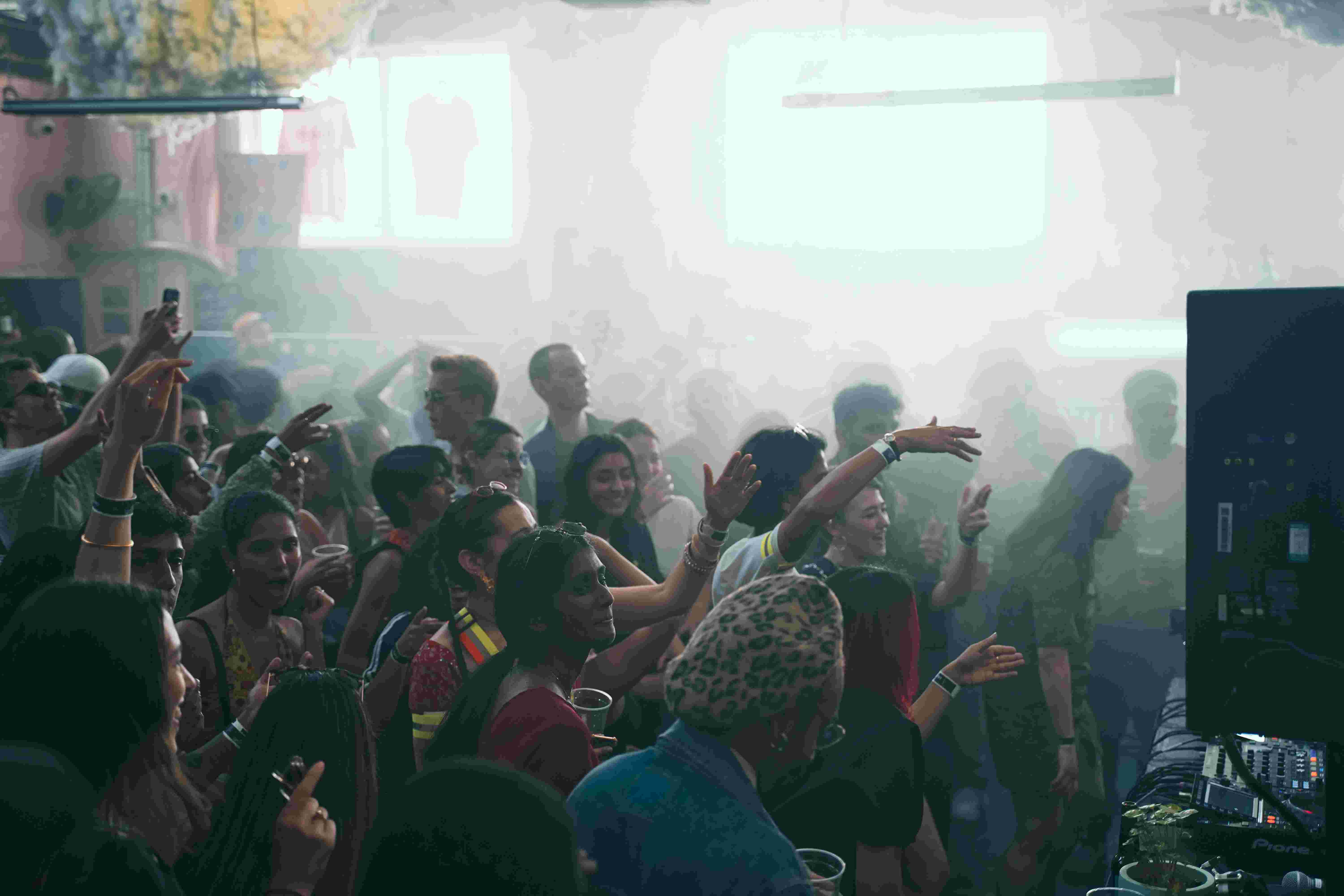
Due to the incredible community we have built across the country and the clarity of our purpose, we are often able to put on an event without a bespoke setup and still see people show up in full force, creating a perfect atmosphere thanks to everyone who shares our ethos. For us, that is the key. We love curating visual elements, but the most important thing is the people on the dancefloor understanding our mission and sharing in the joy of platforming South Asian artists.
Our Hvywght collaboration at Village Underground was a true testament to this - specialist selectors with a killer soundsystem and a simple but effective set up showcasing that the music can also carry the night on its own.
When did you first come across Boomtown, and what was your impression of it?
Boomtown is an institution that anyone in the dance music scene knows as a cornerstone of the culture. In many ways, it shares the same values as DAYTIMERS as an alternative, independent collective dedicated to serving artists and championing progressive values. To be part of it felt natural and like a perfect fit.
Six years in, how do you feel about where the project sits right now? What does the next chapter look like?
We’re really proud of the position we’ve established for ourselves. Six years in, with no sign of slowing down, it shows we’re not just a passing moment. We’re grateful to consistently produce and curate sold out events and to keep creating opportunities for South Asian artists.
The next chapter is about continuing to grow and platforming more people and more artists. At the same time, we want to make sure we never lose sight of our grassroots beginnings. It’s important for us to keep creating pathways for emerging artists.
Beyond this, we want to expand our work outside of music events. We’re excited by what we’ve been building in cultural and arts spaces, particularly with Mehfil, collaborating with organisations like the BFI and Southbank Centre. We want to keep growing this side of our work, from workshops to accessibility initiatives.
What are you most excited about at the moment? a release, a show, a collaboration, or something nobody knows about yet?
This year has been a big one for our cultural work, and it’s something we’re continuing to invest in and grow. We’ve been developing projects that go beyond the dancefloor, creating space for South Asian stories to be explored across film and wider artistic programming. Be sure to keep an eye out for what we’ve been working on with the BFI, as well as our upcoming collaboration with the Barbican and Southbank Centre. These projects are about reflecting the range and richness of South Asian creativity.
If someone reading this has never been to a Daytimers event, what should they expect?
Come with an open mind… ready to dance and feel the love.
More News